











High-Stability Waterborne Polymer Dispersions Using Long-Chain EO Reactive Surfactants
Share
Polymer dispersions prepared by emulsion polymerization are waterborne materials that have attracted attention for their potential to reduce environmental impact and improve safety. They are widely used in a broad range of applications, including paints, coatings, and adhesives. In emulsion polymerization, surfactants play multiple critical roles: they emulsify and solubilize monomers, form micelles that serve as the sites of polymerization, and stabilize the system by preventing polymer particles from aggregating or coalescing during and after polymerization.
However, conventional surfactants are typically physically adsorbed on the surface of polymer particles. As a result, they can desorb relatively easily, which may contribute to foaming in polymer dispersions. In addition, when a dispersion forms a film, surfactants can migrate to the interface with the substrate or to the film-air interface, potentially reducing water resistance and adhesive performance.
One effective approach to address these issues is the use of reactive surfactants. Reactive surfactants contain polymerizable groups in their molecular structure and can copolymerize with monomers. Because they become chemically bound to polymer particles, they can reduce the amount of free surfactant, leading to improved dispersion stability and enhanced film properties.
The introduction of reactive surfactants has enabled reductions in free surfactant content and improvements in film performance. At the same time, as applications become more demanding and distribution conditions diversify, polymer dispersions are required to achieve even higher stability. In particular, ensuring freeze–thaw stability during transport in cold regions and maintaining dispersion stability in the presence of additives such as electrolytes have become important technical challenges.
Against this background, we have focused on molecular design and worked to develop reactive surfactants with optimized EO (ethylene oxide) chain length. We currently offer the HITENOL AR series, which features a styrenated phenyl hydrophobic group— HITENOL AR-05 (5 mol), AR-10 (10 mol), AR-20 (20 mol), and AR-30 (30 mol). We also provide the HITENOL KH series, which uses an alkyl hydrophobic group— HITENOL KH-05 (5 mol), KH-10 (10 mol), KH-20 (20 mol), and KH-30 (30 mol).

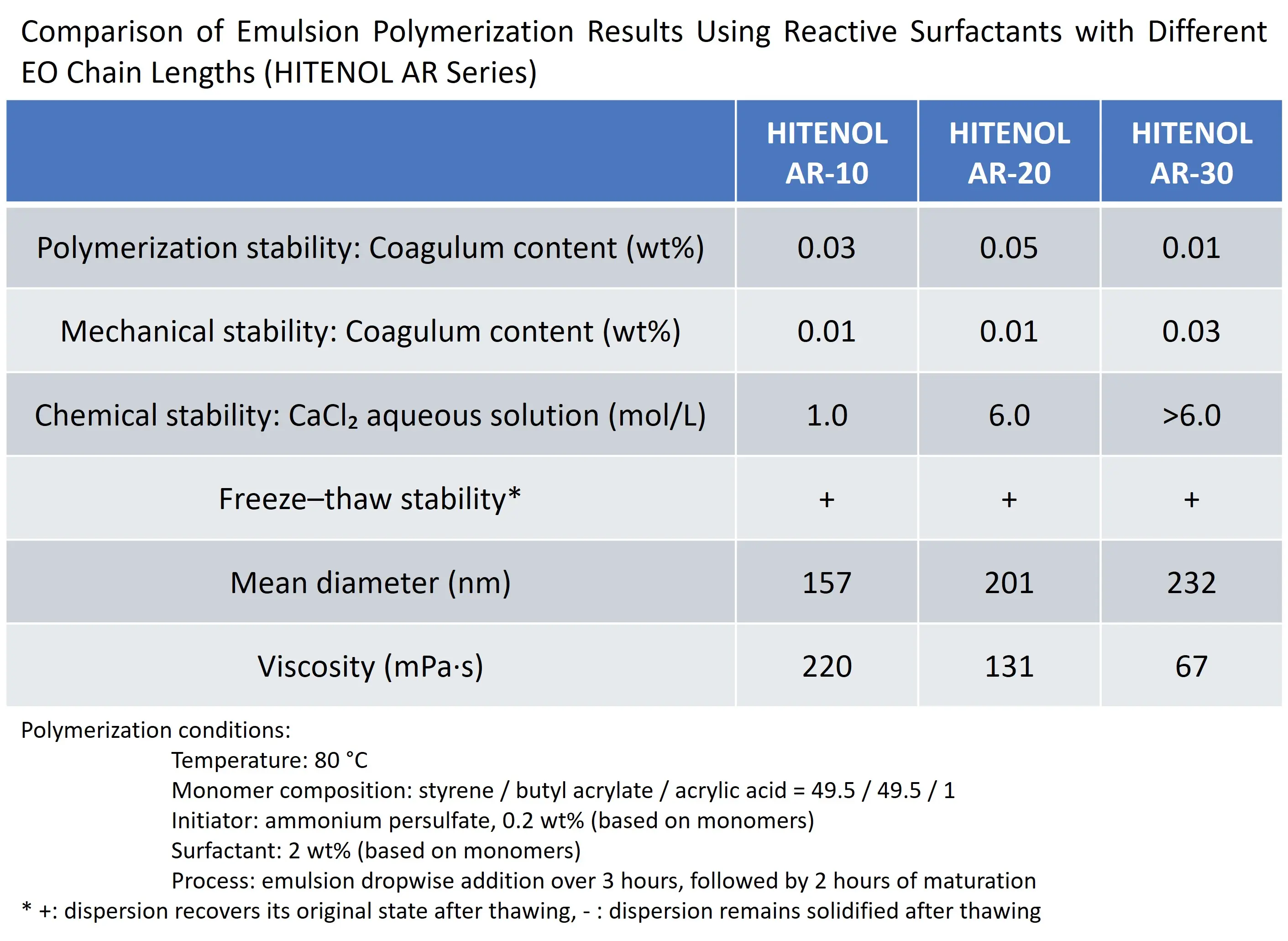
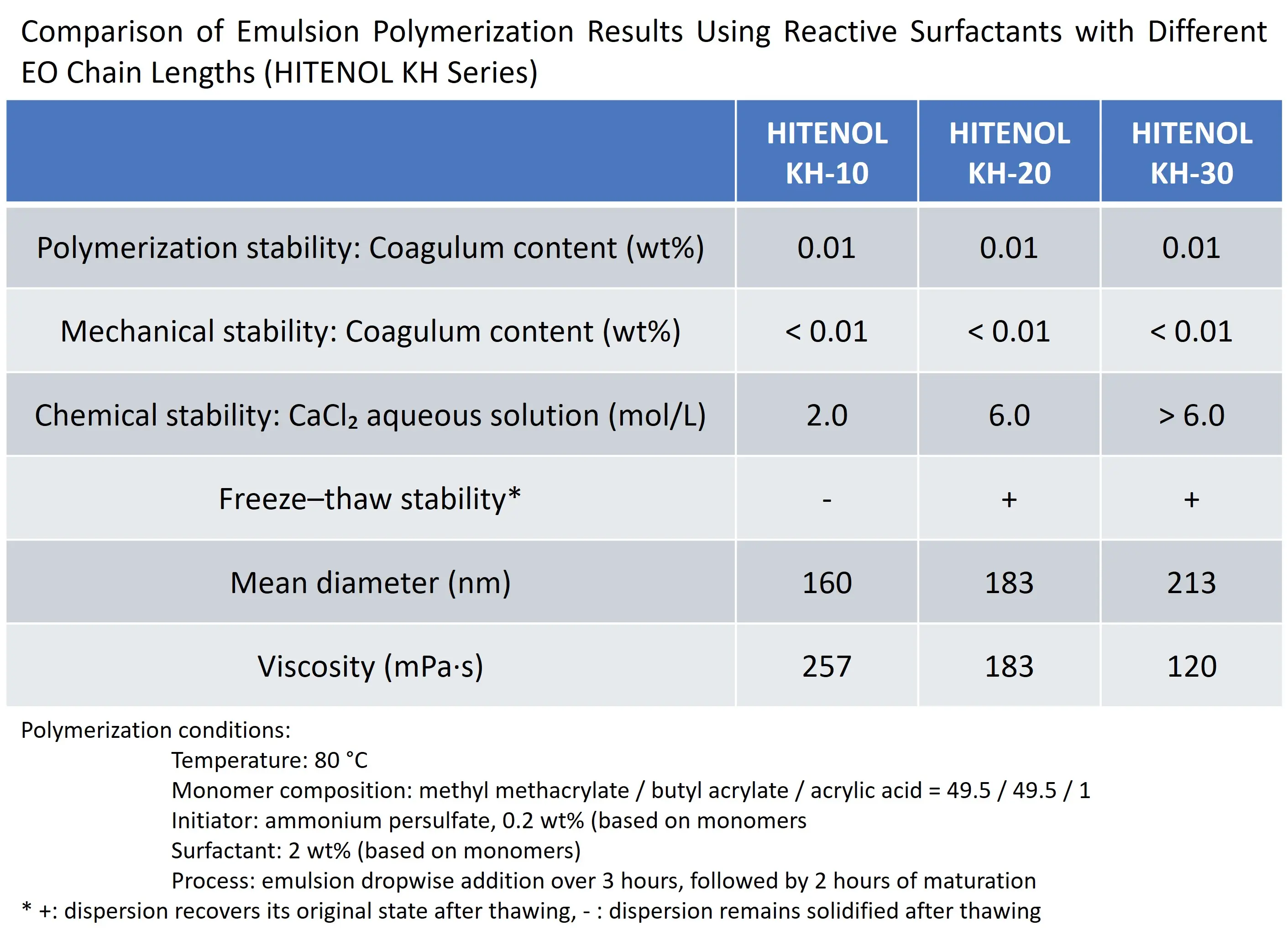
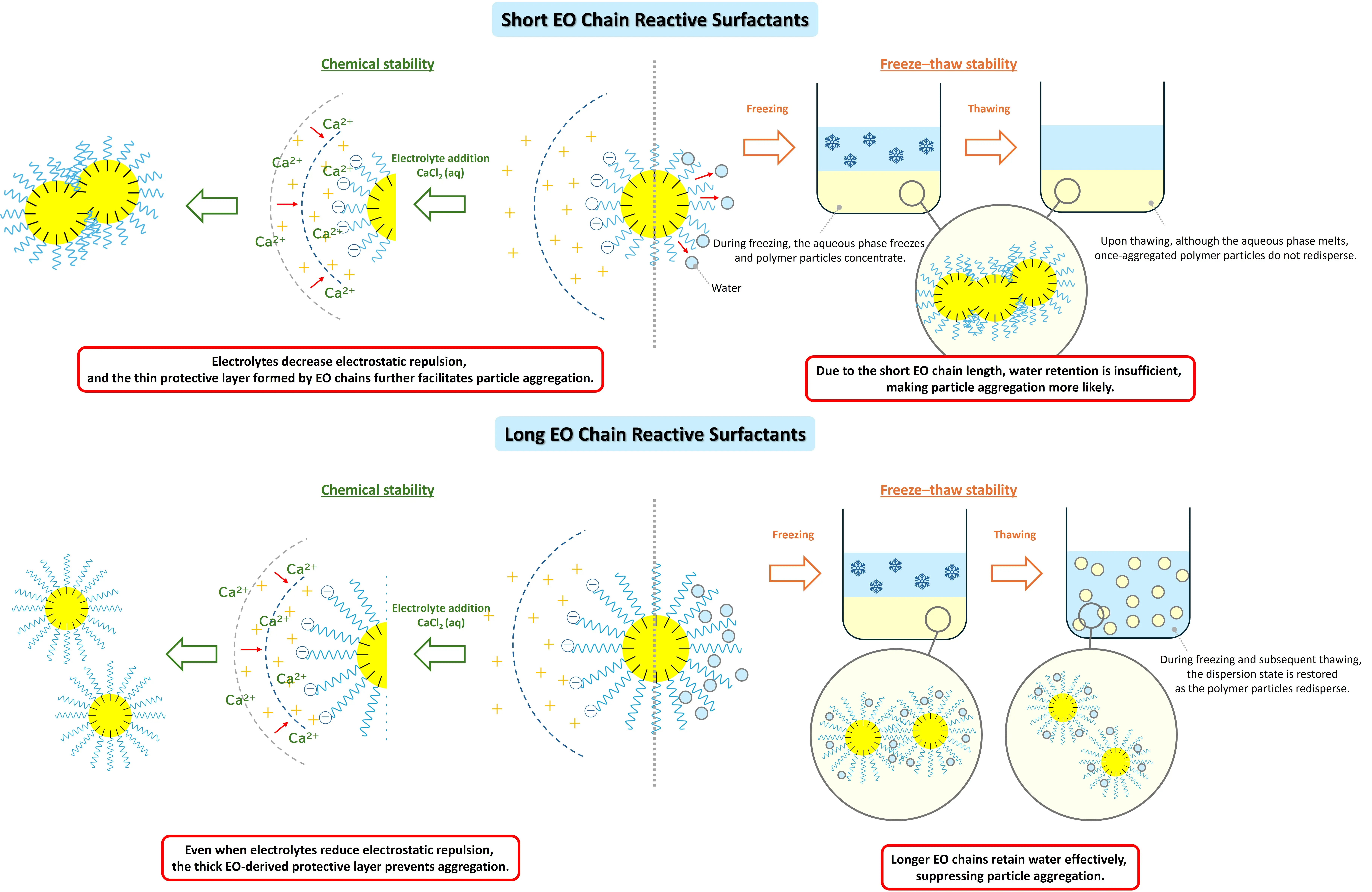
The tables below summarize the evaluation results of polymer dispersions obtained by emulsion polymerization using the HITENOL AR series and the HITENOL KH series. As EO chain length increased, chemical stability improved, showing greater tolerance to higher concentration electrolyte solutions. In terms of freeze–thaw stability, dispersions prepared with the longer EO grades (HITENOL KH-20 and KH-30) recovered to their original dispersed state after thawing.
These results suggest that increasing EO chain length thickens the hydrated layer surrounding polymer particles, enhancing the protective effect at the particle surface and thereby improving overall particle stability.
Demand for reactive surfactants is expanding in overseas markets as well, and meeting the diverse needs of globally operating customers is becoming increasingly important. We will continue to contribute to further functional enhancement of polymer dispersions through optimized formulation proposals.

Surfactants Group
Core Materials R&D Department
Core Materials Business Division
Business Headquarters
TANAKA Mayu