










Responsible Care
Responsible Care Activities
In the chemical industry, "responsible care" refers to voluntary initiatives in which companies that handle chemical substances ensure environmental protection, health, and safety throughout all stages—from development and manufacturing to logistics, use, final consumption, and disposal—while disclosing their performance and engaging in dialogue with society. Guided by our fundamental principles and policies on environmental protection and safety, we actively promote responsible care activities.
Basic Philosophy
We have established the following as our basic philosophy on environmental protection and safety.
Through all of our business activities, we aim to be a company that prospers together with the local community and our employees by delivering products that satisfy our customers, thereby contributing to the creation of a prosperous society. Based on this philosophy, we have defined our basic stance on environmental and safety initiatives as follows:
"From product development to disposal, we consider human safety, health, and environmental conservation throughout the entire product lifecycle, contributing to sustainable development and the realization of a prosperous society."
Basic Policies
We have established the following basic policies on environmental protection and safety.
- Evaluate and reduce environmental impact throughout the entire product lifecycle, from development to disposal, and work to protect the environment.
- Maintain accident-free and disaster-free operations to ensure the safety of the local community and employees.
- Verify the safety of raw materials, intermediates, and products, and prevent health hazards for employees, logistics personnel, customers, consumers, and all related stakeholders.
- In addition to complying with applicable laws and regulations, also pursue continuous improvement in environmental and safety performance through voluntary management.
Action Guidelines
We have established the following action guidelines on environmental protection and safety.
- Assess the impact of business activities on the environment and safety, set environmental and occupational safety goals, regularly review them, and pursue continuous improvement in environmental conservation and occupational health and safety activities.
- Comply with environmental and occupational health and safety laws, regulations, and agreements, while striving to coexist harmoniously with the local community.
- To reduce environmental impacts, we will promote resource and energy conservation, waste reduction and recycling. In addition, we will advance initiatives to improve occupational health and safety across all business activities.
- In developing new products and technologies, consider environmental protection and safety, recognize the environmental impacts of products, and work to ensure that safe products are delivered.
- Conduct environmental and safety education and internal communication activities to improve understanding and awareness among all employees, and request the understanding and cooperation of partner companies.
Promotion System
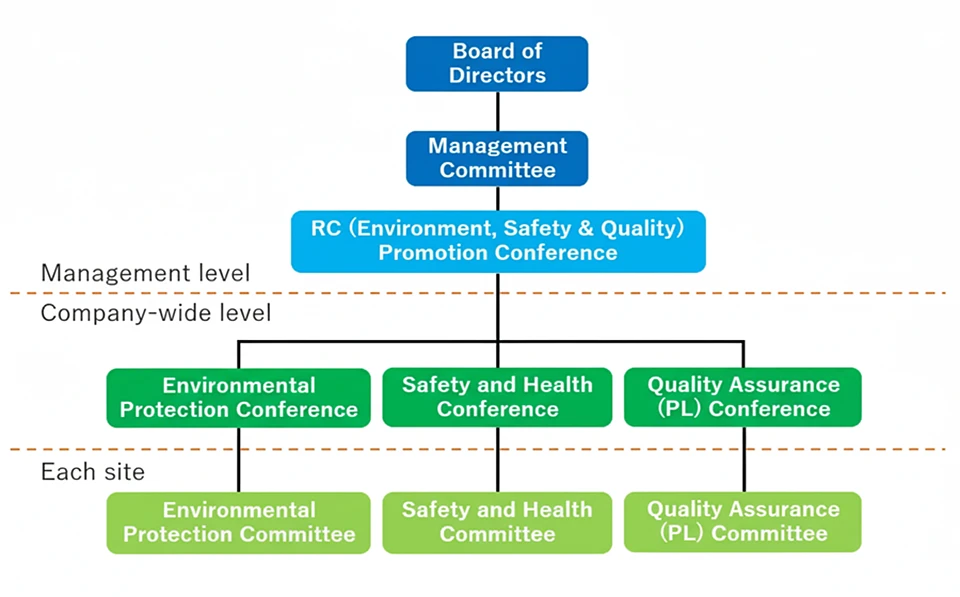
We promote activities related to environmental protection, safety, and quality based on our established basic philosophy, basic policies, and action guidelines. The RC (Environment, Safety & Quality) Promotion Conference, chaired by the CEO, serves as the highest decision-making body, deliberating and deciding on agenda items. The Environmental Protection Conference, the Safety and Health Conference, and the QA (PL) Conference are chaired by the executive in charge of environment, safety, and quality assurance, with plant managers and relevant department heads serving as members. These conference groups deliberate on company-wide goals, implementation plans, and results, and work to advance responsible care activities. Subcommittees under each conference group develop, implement, and review action plans to ensure continuous improvement.
ISO Certification Status
ISO certifications obtained across our Group are as follows.
| Base Name | ISO 9001 | ISO 14001 | ISO 45001 |
|---|---|---|---|
| Yokkaichi Plant, DKS Co. Ltd. | ○ | ○ | ○* |
| Ohgata Plant, DKS Co. Ltd. | ○ | ○ | ○* |
| Shiga Plant, DKS Co. Ltd. | ○ | ○ | ○* |
| Yokkaichi Chemical Co., Ltd. | ○ | ○ | |
| Kyoto Elex Co., Ltd. | ○ | ○ | |
| Dai-ichi Ceramo Co., Ltd. | |||
| IKEDA YAKUSOU CO., LTD. | ○ | ○ | |
| Chin Yee Chemical Industries Co., Ltd. | ○ | ○ | ○ |
| PT DAI-ICHI KIMIA RAYA | ○ | ||
| KYOTO ELEX (Suzhou) Co., Ltd. | ○ | ||
| Acquisition rate | 90% | 70% | 40% |
- JIS Q 45100 certification.
Product Safety Mechanism (chemical substance management from design development)
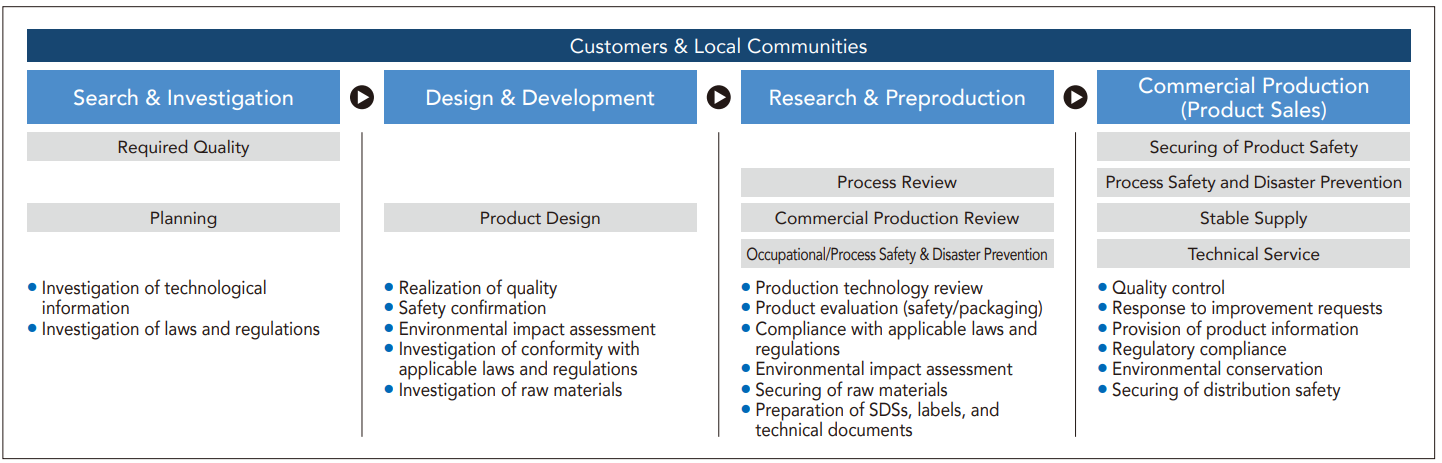
At each stage of product development, from research and exploration to prototyping and mass production, DKS conducts surveys of laws and regulations as well as evaluations of environmental impact, and carries out design and development with the utmost consideration for product safety. In addition, by introducing a chemical substance management system, we conduct GHS*1 classification, check laws and regulations, create multilingual SDS*2 and labels, investigate substances contained in items such as our products, and are promoting the appropriate communication of information about our products.
- Globally Harmonized System (GHS) of Classification and Labeling of Chemicals
- Safety Data Sheet (SDS): A sheet containing information on the properties and handling of chemicals when transferring or providing them to other business operators
to scroll
Occupational Safety Initiatives
Continuous Improvement through the Occupational Safety and Health Management System
We recognize that ensuring the safety and health of our workers is the foundation of our business activities. To this end, we have established policies subordinate to the Environmental Conservation, Health and Safety Management Regulations. We have also obtained the certification of the Occupational Safety and Health Management Systems (JIS Q 45100) at our three domestic plants.
In 2024, one lost-time injury occurred, the same number as in the previous year. We have taken appropriate corrective actions and implemented thorough measures to prevent recurrence. We aim to achieve zero occupational accidents (lost time) in 2025 by strengthening our risk assessments and other safety activities.
Number of Occupational Accidents (Fatal Accidents), Occupational Accident Frequency Rate and Occupational Accident Severity Rate
to scroll
| 2022 | 2023 | 2024 | |||
|---|---|---|---|---|---|
| Occupational accidents (fatalities) Number of cases | DKS Group | Permanent employee | 0 | 0 | 0 |
| Contract employee | 0 | 0 | 0 | ||
| DKS | Permanent employee | 0 | 0 | 0 | |
| Contract employee | 0 | 0 | 0 | ||
| Occupational accidents (lost time injuries) Frequency rate*1 | DKS Group | 0.58 | 0.58 | 0.59 | |
| DKS (non-consolidated) | 0.00 | 0.00 | 0.00 | ||
| Chemical Industry | 1.16 | 1.04 | 1.23 | ||
| Occupational accident severity rate*2 | DKS Group | 0.00 | 0.00 | 0.00 | |
| DKS (non-consolidated) | 0.00 | 0.00 | 0.00 | ||
| Chemical Industry | 0.06 | 0.03 | 0.04 | ||
- Frequency rate = number of lost-time injuries ÷ total hours worked × 1,000,000
A figure that shows the frequency of injuries per million total hours worked - Severity rate = number of days lost due to injury ÷ total hours worked × 1,000
A figure that shows the severity of injuries per 1,000 total hours worked
Implementation of Hands-on Safety Training
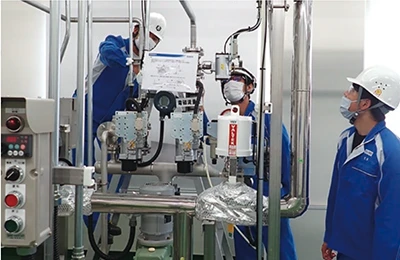
In February 2017, the Company established the safety training center at the Yokkaichi Plant Kasumi Area to enhance employees’ awareness of potential abnormalities and dangers on-site. At the training center, participants can experience simulated work-related accidents and other dangerous accidents using virtual reality and various hands-on training devices. A mini plant has also been established to help employees gain better understanding of the basic principles of equipment and processes. In fiscal 2024, a total of 65 employees participated in hands-on safety training and related programs using these facilities.
Training on Occupational Safety
| FY2022 | FY2023 | FY2024 | |
|---|---|---|---|
| Number of participants in hands-on safety training | 90 | 70 | 65 |
Initiatives for Logistics Safety
DKS entrusts external vendors with its logistics operations that involve product storage and transport. However, in adherence to the spirit of Responsible Care, our activities are guided by our stance that we will secure logistics safety and preserve the environment, as well as offer to customers guarantees of logistics quality and service delivery, among other principles. We work in close collaboration with our vendors to promote initiatives for logistics safety to realize these goals.
One particular aim we have is to eliminate accidents in logistics. To achieve this, we hold regular committee meetings to share information, consult, and educate on maintaining safe transport and traffic order, understanding amendments to laws, following delivery operations’ safety and environmental standards, understanding shipping specifications, and other topics.
In addition, in the event that an accident occurs during the transport of chemicals, so that drivers can take proper measures, we provide Yellow Cards* that indicate the Emergency Response Guidebook (ERG) number and the UN number as well as Container Yellow Cards indicating the same on the product labels.
- An emergency contact card used when products are being delivered. In preparation for the event that an accident occurs during the delivery of chemical substances, this emergency contact card indicates the measures that should be taken by the relevant people.
Initiatives for Disaster Prevention
Response in Emergency Situations (Conducting Disaster Prevention Drills)
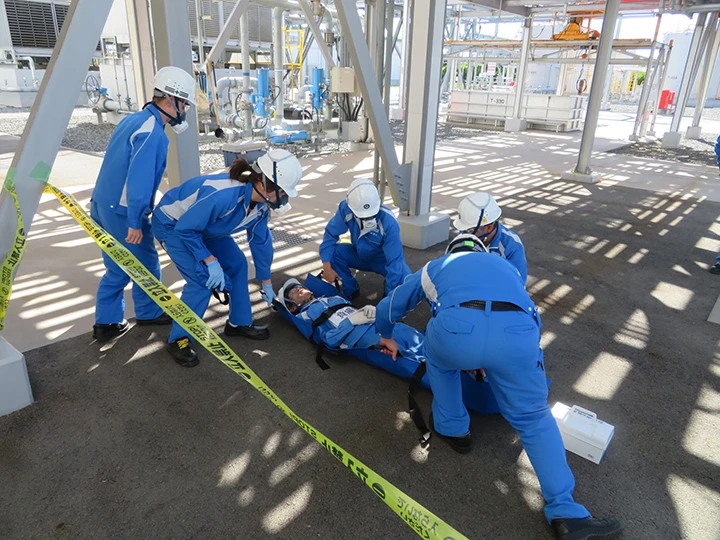
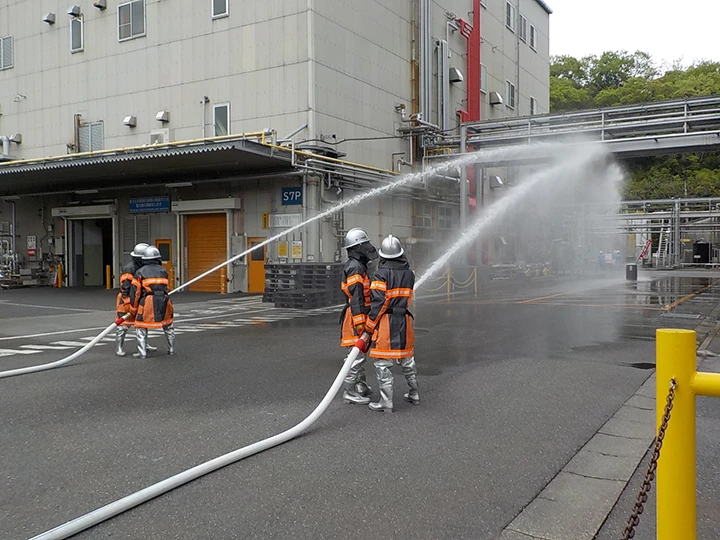
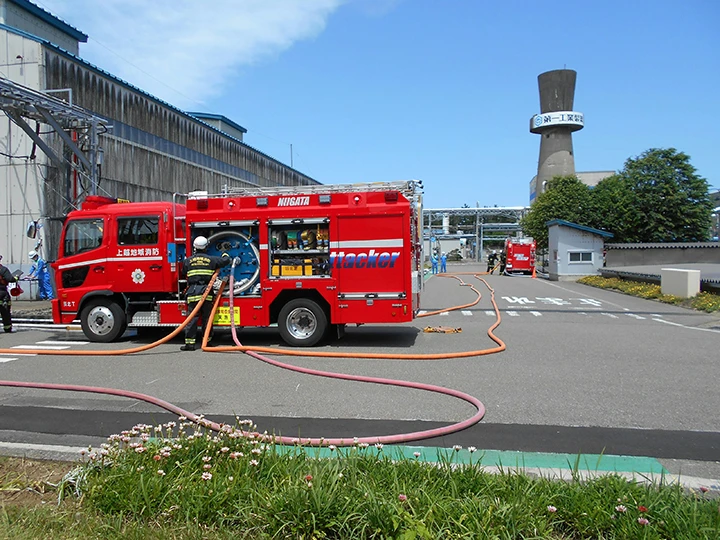
As preparation in case an emergency situation arises due to fire or explosion, earthquake, leakage, power outage or other events, we have constructed a framework for disaster prevention at every branch and carry out repeated disaster prevention drills in accordance with fiscal year plans. We have also taken measures to prepare in the event of such accidents and have developed a disaster prevention manual for emergencies based upon the incidents of large-scale fires and explosions that have occurred at domestic chemical factories in recent years. Disaster prevention drills are also performed with the cooperation, and in unison, with local fire departments and/ or public fire brigades. We continue to work on disaster prevention activities that will prevent accidents and disasters specific to a chemical manufacturer to ensure that they do not occur in the first place.
Disaster prevention measures
| FY2022 | FY2023 | FY2024 | |
|---|---|---|---|
| Investment in disaster prevention measures (million yen) | 582.5 | 374.3 | 398.1 |