











Executives and Auditors’ Roundtable Discussion
Executives and Auditors’ Roundtable Discussion Sustainability Envisioned in SMART 2030
-
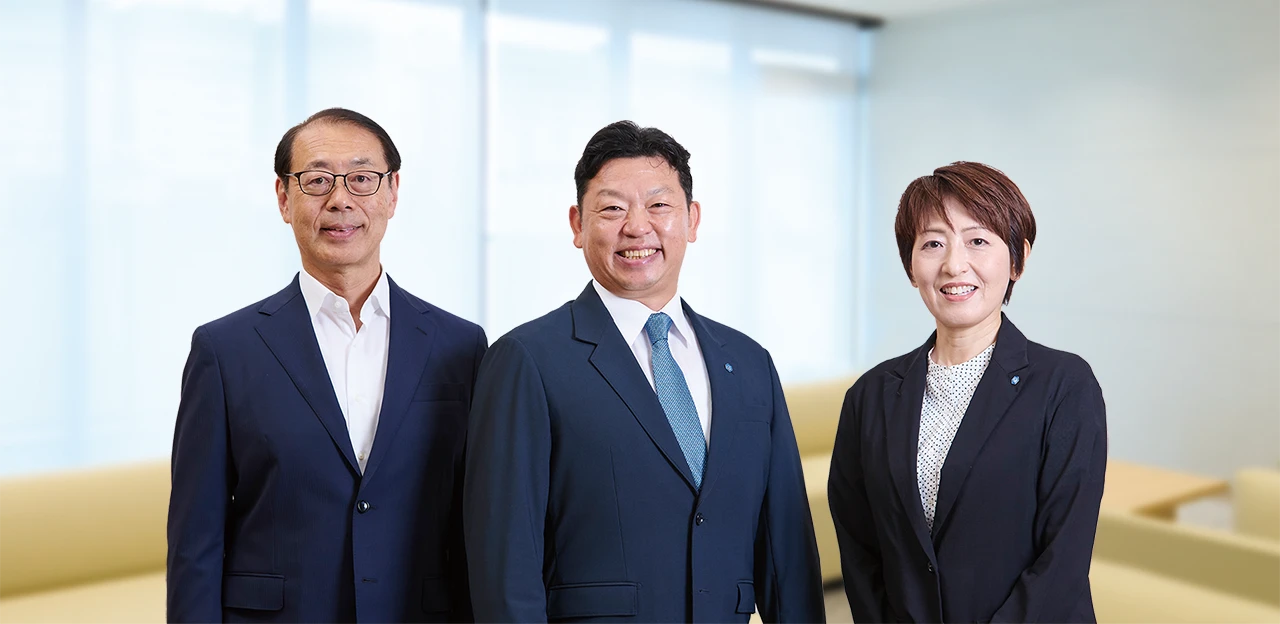
Outside Audit & Supervisory Board MemberMIYANAGA Masayoshi(on the left in the photo)
MIYANAGA Masayoshi worked at The Nippon Credit Trust Bank, Ltd. before becoming Director of Schroder Investment Management (Japan) Limited. While serving as Chief Investment Officer in charge of Stock Investment at Prudential Asset Management Japan Co., Ltd., he became Representative Director of FALCON Research & Consulting, Ltd. (current). He is now concurrently serving as specially appointed professor at Chuo Business School and Outside Director of Universal Entertainment Corporation and S.T. CORPORATION. He has experience in business management and academic knowledge in the areas of corporate valuation, corporate finance, and related fields accumulated as a university professor. He has been serving as an Outside Audit & Supervisory Board Member of the Company since June 2024.
-
Representative Managing Director & CFOSHIMIZU Shinji(in the center in the photo)
SHIMIZU Shinji joined the Production Section, Yokkaichi Plant of the Company in 1992, going on to serve as General Manager of Personnel & General Affairs Headquarters, General Manager of an overseas subsidiary in China, General Manager of Financial Division, Financial Headquarters, and Executive Officer and Executive General Manager of Production Headquarters. He became Director in 2022 and Representative Managing Director & CFO in April 2025. He has a wealth of experience and knowledge in administration and planning, production and management of production subsidiaries, and other fields, and is also well-informed about finance and accounting.
-
Director & Senior Executive General Manager, Administration HeadquartersSAKAMOTO Mami(on the right in the photo)
SAKAMOTO Mami was engaged in textile chemical research for 22 years, after joining our R&D Division in 1988. She later served as General Manager of West Sales Department, Surfactants Business Division, General Manager of the President’s Special Mission Office, General Manager of the Public Relations and Investor Relations Office, and General Manager of the Administrative Headquarters. She became an Executive Officer in 2020, and Senior Executive Officer in 2024 (current). She is a pioneer in female managerial positions, skillfully balancing work with life events such as marriage and parental care, and contributes to improving the level of comfort at work for women and diversity. She became Director in June 2025.
Strengthening the Sustainability Structure, with Business Continuity as the Top Priority
-
MIYANAGA
The new Medium-Term Management Plan "SMART 2030" (hereinafter the “Plan”) was formulated in June 2025, when you, Ms. Sakamoto, now a Director, were Executive General Manager of the Strategic Management Division. The Strategy Headquarters’ Strategy Planning Department played a central role in developing the Plan in collaboration with each headquarters. The “S” at the beginning of SMART stands for sustainability but I’d like to ask you what this means.
-
SAKAMOTO
The “S” means pursuing business in a sustainable manner. Consideration for diverse stakeholders including local communities, employees, and supply chains is essential for business continuity. President Yamaji attaches particular importance to human capital. Since the technological skills and knowledge of employees underpin all our activities, including research and development, production sites and safety management, we are going to invest in training in an attempt to cultivate the human capital required to maintain business continuity. Moreover, in this Plan, we use the expression “Jinzai (human capital)” to emphasize that our employees are a valuable asset.
-
SHIMIZU
I agree that human capital is of prime importance. Our new Plan clearly advocates strategic human capital development, improvement of labor productivity, and employee autonomy leading to corporate growth, and our policy is to consider employees not merely as human resources but as human capital and to actively invest in it.
-
MIYANAGA
At the same time, we must also pay attention to factors outside the Company. As we strengthen group management and expand operations overseas, respect for human rights in the supply chain is a consideration that cannot be overlooked, and concrete measures are required.
-
SAKAMOTO
Yes, I agree. First, it is important to share quantitative targets for individual measures across the Company, develop specific measures, and incorporate them into management strategies. This year, we have begun reviewing the structure of the Sustainability Committee, and supply chain divisions are now participating. Starting next fiscal year, the committee will be chaired by the president, and I expect the committee’s power to drive measures forward will increase further.
Achieving carbon neutrality through DKS’s unique technologies and materials
-
MIYANAGA
Under the new Plan, carbon neutrality (CN) is also an important issue. However, environmental issues are an area where it is difficult to achieve short-term results, so the effort and awareness of each individual is important. How do you plan to accelerate initiatives to reduce greenhouse gas (GHG) emissions and achieve carbon neutrality by 2050?
-
SHIMIZU
Since 2002, DKS has been engaged in environmental management, starting with the ISO14001 certification. The Quality Assurance Department (then the Environment, Safety and Quality Department) of Production Headquarters has played a central role in promoting carbon neutrality. By repeating cycles of identifying issues, evaluating and scoring performance and reflecting areas for improvement in targets, this process has become well embedded. However, it is not yet fully adopted throughout the Company, and under the Plan, the management strategy divisions have taken the lead in initiating companywide activities.
-
MIYANAGA
There are many different environmental indicators, and it is important to set the figures of benchmark companies as relative targets. At the same time, internal absolute targets have been set under the Plan of increasing the sales ratio of products that contribute to the environment to 30% or higher, reducing GHG emissions by 30% compared to 2013, and achieving a modal shift rate of 40% or higher.
-
SAKAMOTO
More specifically, each department is implementing energy-saving measures, such as increasing the efficiency of steam traps, with the aim of expanding environmentally friendly products and reducing environmental impacts in manufacturing processes. However, it is important to define such products, so the sustainability staff have been reviewing and classifying our existing products according to their environmental contribution. Fortunately, our product lineup contains many environmentally friendly materials and we believe that, through development using these materials, our employees will naturally become conscious of sustainability.
-
MIYANAGA
To raise awareness within the Company and ensure company-wide adoption, one effective approach is to link the reduction of environmental impact through environmentally friendly products to incentives and performance evaluations. This can help boost motivation. Additionally, incorporating the contribution of such products to sales growth as an evaluation criterion would also be beneficial.
-
SHIMIZU
In fact, we now also have a program for honoring employees who have contributed to corporate value, an idea proposed by President Yamaji. At the same time, sales and environmental measures tend to run contrary to one another. In fiscal 2024, our net sales increased, but the amount of waste generated also increased. Herein also lies the difficulty for a chemical manufacturer. To address such problems, we need environmental measures that do not negatively impact our sales and profit. To give a specific example, we have developed products from recycled waste through the crystallization of sodium acetate hydrate. With the growing interest in sustainable raw materials, we are currently in the process of evaluating applications with multiple business partners and are also establishing a mass production system. We are also working on reducing energy consumption during transportation by using spray drying technology to turn liquid products into powder. This pulverization technology itself consumes a large amount of energy but we have introduced equipment at the Shiga Plant to reduce this consumption to one tenth of its previous level.
Introduction of a New Personnel System Based on “Challenge”
-
MIYANAGA
The Plan sets forth a strategy of rebuilding the personnel system, and the Company is working to improve employee engagement and transform the corporate culture. To coincide with this, the evaluation system has changed considerably since this April. I heard that reform of the personnel system was very time and labor intensive. How do you think this will help strengthen human capital?
-
SAKAMOTO
We made a start on reforming the personnel system in 2020. We spent a year holding discussions, but the process was subsequently put on hold for three years. We spent another year on discussions in 2024, before making a start from this April. A major feature of the new system is that we included the word “Challenge” among the three keywords central to the Plan. Under the new system, people who have outperformed the set targets are fairly evaluated. We aim to foster a corporate culture that acknowledges and celebrates the very act of taking on challenges without fear of failure, regardless of the results of doing so.
-
MIYANAGA
This is a very good initiative; however, under this mechanism, evaluation tends to differ depending on the assessor. For example, unlike undergraduate programs, many specialized courses at the business schools and graduate schools where I teach do not have exams or assignments where there is a single correct answer, and subjective evaluations differ depending on the professor. As a result, when some professors give lots of S and A grades, the GPAs of students who take the courses of such professors end up being relatively high. Quite a few graduate schools have, therefore, decided to evaluate students relative to their peers and set a maximum percentage of students receiving S and A grades. DKS also needs to use unified evaluation criteria to increase the effectiveness of the recent reform of the personnel system.
-
SAKAMOTO
Differences in evaluation criteria and evaluations among departments can lead to employee dissatisfaction, which has been a frequent concern among employees. Consequently, we are repeatedly providing training to standardize evaluation criteria to enhance the understanding of managers involved in assessment. Some have pointed out that departments with a lot of routine work tend to receive lower evaluations. Efforts in improving work operations, for example, through use of DX, will also be evaluated. At any rate, we want to share the value of continuing to take on challenges throughout the entire Company.
-
MIYANAGA
I think it’s a really positive, good initiative. But in reality, people within the same organization tend to go along with the status quo and this is usually not very conducive to taking on challenges. For employees to take on challenges, it is important to make them want to do so. In particular, through dialogue with their managers, employees should feel supported and managers should actively encourage the training and study needed to acquire the necessary skills. The support from organizations, especially from managers, is necessary, right?
-
SAKAMOTO
Yes, that’s true. All the same, when it comes to taking on challenges, individual initiatives are important. Accordingly, skill development opportunities are voluntary, not mandatory. Furthermore, if we see certain individuals as potential candidates in charge of certain areas in the future, it is important, for example, to suggest during one-on-one meetings that they participate in relevant training programs. Of course, if employees indicate an interest in training themselves, we intend to respect their wishes and support them as much as possible.
-
MIYANAGA
Going back to the new personnel system, it would be possible to conduct a survey of employees to assess the impact of this system reform. I think it’s important to gather feedback and comments especially from employees who have noticed a change.
-
SHIMIZU
President Yamaji has also pointed out the importance of a survey to find out the opinions and thoughts of employees and so we are currently considering collecting data by using generative AI to create natural questions for employees to answer. I have always believed that new systems only take root when both people and organizations change, leading to a shift in employee mindset. Since on this occasion the system was implemented first, I believe it is important to observe how the employee mindset changes with the passage of time.
Efforts to strengthen human capital of DKS
-
MIYANAGA
There have been strong calls about strengthening human capital recently and, given that an organization is powered by people, human capital may be more important than financial capital. While financial control generally follows standard practices and is not very complex, human capital management is highly complex and finding a solution is by no means easy. First, DKS promoted health and productivity management. How do you evaluate the Company’s performance in this regard?
-
SHIMIZU
Since the days when Senior Advisor Sakamoto was President, we have continuously focused on human capital. We have also created a health and productivity management strategy map, properly determined KPIs, and are properly monitoring health and productivity management targets and health management targets. The change in employee behaviors is evident in the response rate to health checkups and the rate of follow-up health examinations, which are both almost 100%.
-
SAKAMOTO
Health management in day-to-day life is also important. DKS employees use an app to take photographs of their meals and calculate the calories, and we organize company-wide walk-a-thons. Participants receive points according to their ranking, which can be exchanged for meal vouchers, Amazon gifts, and other items. The regular exercise habit rate increased from 13.6% in 2016 to 27.1% in 2024, jumping 13 percentage points. Absenteeism has also been steadily falling since 2019.
-
MIYANAGA
In connection with human capital management, DE&I is often emphasized. Recently, in the United States, DE&I appears to have become a taboo subject; however, I believe that many aspects of DE&I should still be promoted in Japan. The targets for the Plan include a female manager ratio of 15% or higher. Currently, this rate stands at around 10% and to achieve this target, we probably need to work on creating an environment in which women are encouraged and motivated to pursue managerial positions.
-
SHIMIZU
Whether improvement in the ratio of women in managerial positions is achieved in the short term or the medium to long term depends on an organization’s approach. I believe that, even without measures to forcibly improve the rate in the short term, the ratio will still improve naturally over the medium and long term. This is because the ratio of women among both new graduate and mid-career hires is increasing and, provided the foundations for them to continue working with peace of mind are in place, the ratio of women in managerial positions will also improve as a matter of course. Going slightly off topic, but when I was at a subsidiary in China, the subsidiary had around 100 employees, around 80% of whom were women. In China, partly due to the one-child policy, the time spent bringing up children is not so long, and childcare is shared between the parents and the grandparents, creating an environment where both men and women can work. Additionally, women demonstrate strong management skills, and the ratio of women occupying leadership positions is also high.
-
SAKAMOTO
The environment is quite different from that in Japan. Granted, many women in Japan do not want to become managers for various reasons; however, recently there is a tendency for men to avoid management positions as well. This is mainly because men think being a manager looks like a lot of work for the pay received. In the latest reform, we, therefore, also reviewed both managers’ compensation and work styles. Women are often weighed down by childcare and nursing care responsibilities. Personally, I am still caring for my mother with support, but things were tough when I was looking after both my parents. Fortunately, I was able to continue working without giving up my career, thanks to the Company’s employee welfare benefits. We live in an era where human capital outflow is an issue, and flexibility, including showing respect for work-life balance when redeploying labor, will help us secure human capital.
-
SHIMIZU
Recently, in a conversation with a female manager at an employment agency, I was told that, from a career perspective, it’s better for women to return to work sooner rather than later after giving birth. I was told that although a woman must be given the option to take a long period of maternity leave, measures for filling career gaps and support to enable an early return to work must also be made available to career-minded employees. We must, therefore, be flexible and provide employees who wish to return to work early with childcare support systems and consideration.
Taking strategic steps to enhance next-generation governance
-
MIYANAGA
Finally, I would like to ask you, Mr. Shimizu, who became Representative Director this year, what kind of systems do you think will be needed in future to strengthen DKS’s corporate governance? I also believe that the selection of Ms. Sakamoto as DKS’s first female Executive Director and the selection of Mr. Kitao as Director at a relatively young age shows that DKS’s management team is becoming younger and evolving.
-
SHIMIZU
For achieving progressive management at DKS, collaborative creation with younger executives as well as outside officers and other experienced and knowledgeable individuals is important. Over the period of SMART 2030, I intend to strengthen our corporate governance by re-envisioning a new Board of Directors system and advancing towards this vision. In some cases, the system of a company with three committees, including a Nomination Committee, which was introduced from overseas, has not always produced good results. Meanwhile, the system of a company with an Audit & Supervisory Committee that is unique to Japan has become fairly common. However, compared to companies with an Audit & Supervisory Board, the supervisory function may be weaker because it is not based on individual independence (dokunin-sei) among auditors. Going forward, I intend to determine a suitable institutional design for DKS and combine the emerging strengths of the current members with fresh human capital to bring about further business continuity and growth in the future.