Differentiated by adhesiveness, blocking resistance, and UV resistance
Waterborne Polyurethane Dispersion (PUD) Primer Technology
Fumiya Kaneko | Device Materials R&D Group,
Electronics & IT R&D Department,
Electronics & IT Business Division,
Business Headquarters
Flat panel displays (FPDs) are used in smartphones, televisions, and other devices, and are projected to grow at a CAGR of approximately 3% on an area basis 1).
Optical functional films are used in FPDs to impart properties such as scratch resistance and anti-reflection.
These optical functional films consist of a substrate and a functional layer. To achieve strong adhesion between them, PUDs are used as primers. In addition to initial adhesion, the primer is required to provide blocking resistance and adhesion durability after UV exposure.
◆ ◆ ◆
This article presents the excellent performance of our thermoreactive PUD primers for optical applications, as well as our newly developed polymer-type PUD primers.
Optical Functional Films
Optical functional films used for FPDs employ substrates such as polyethylene terephthalate (PET), cellulose triacetate (TAC), and cycloolefin polymer (COP). These substrates are selected depending on the required characteristics, including transparency, heat resistance, and impact resistance.Among these substrates, PET film provides an advantageous balance of rigidity, transparency, and cost. It is widely used for protection films for polarizers, anti-reflection films, and films around the backlight unit.
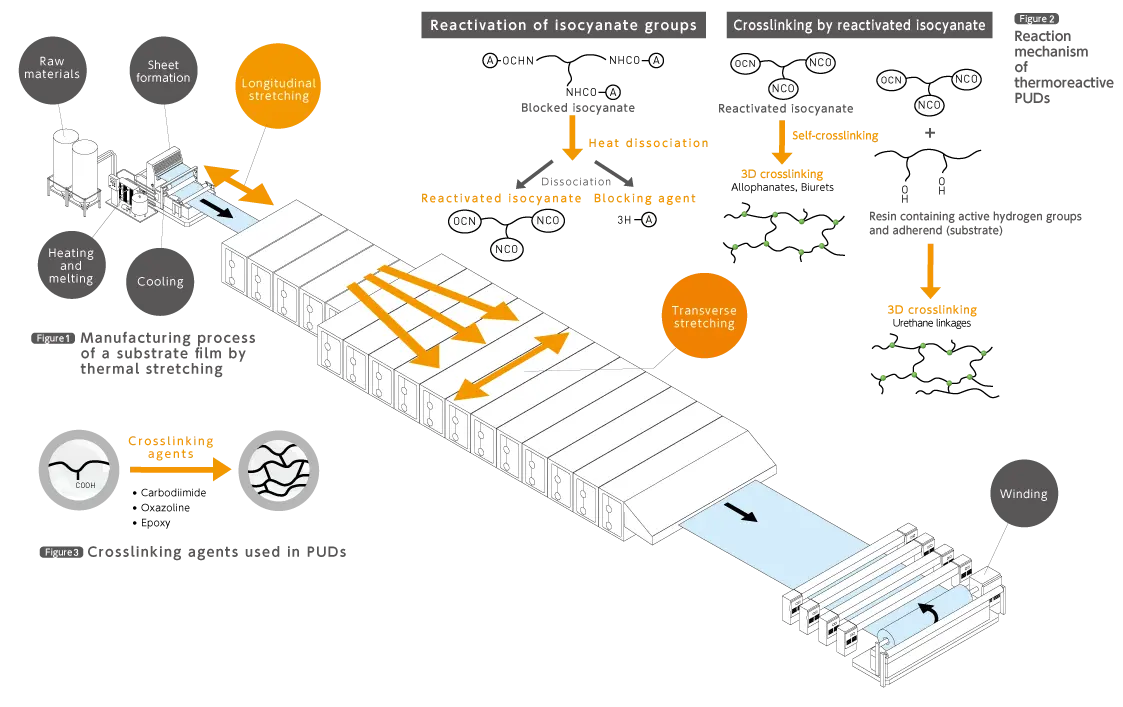
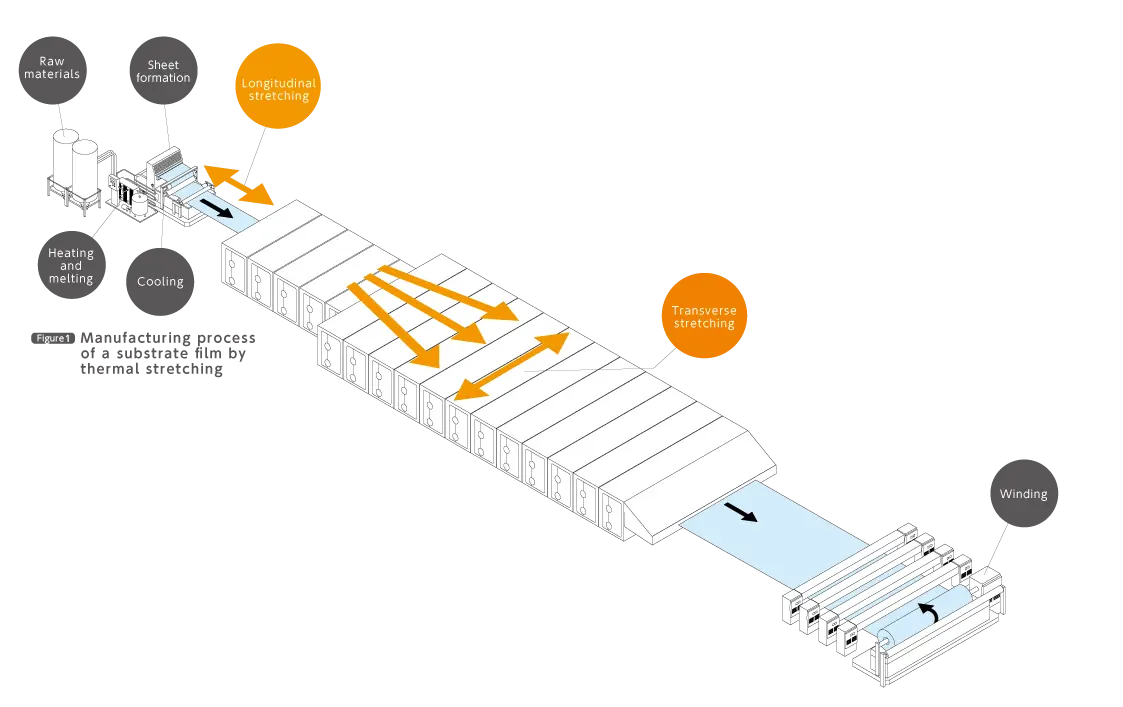
In optical applications, PET film is generally formed by thermal stretching (Figure 1).
Thermal stretching induces high crystalline orientation at the film surface, which lowers the surface free energy and renders the surface chemically inert. As a result, adhesion to the functional layer becomes poor. Therefore, surface modification is required to improve adhesion.
Common surface-modification methods include corona discharge treatment and primer treatment.
In corona discharge treatment, corona discharge forms hydroxyl and carbonyl groups on the film surface, improving adhesion. If adhesion is still insufficient, primer treatment is used.
Primer treatment involves applying a thin primer layer, such as PUDs, on the substrate film, which significantly improves adhesion between the substrate and the functional layer. For the functional layer, UV-curable coatings are mainly used due to the required properties.
DKS’s PUD Technology
PUDs are aqueous dispersions of urethane resins obtained through the polyaddition reaction of polyols and isocyanates. They are broadly categorized into thermoreactive and polymer types.
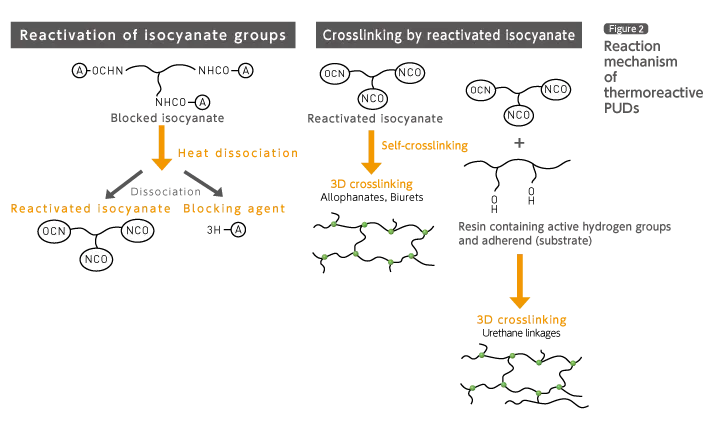
Thermoreactive types are low- to medium-molecular-weight urethane resins dispersed in water, in which isocyanate groups are protected with blocking agents. When heated, the blocking agent dissociates and the isocyanate groups are reactivated. These reactivated isocyanate groups undergo self-crosslinking or react with resins containing active hydrogen groups or with the substrate (adherend), forming a 3D crosslinked structure 2) (Figure 2).
Our thermoreactive PUD series, which has a proven track record as a film primer, uses a low-temperature dissociation-type blocking agent. Dissociation performance is enhanced by adjusting the coating solution to neutral pH.
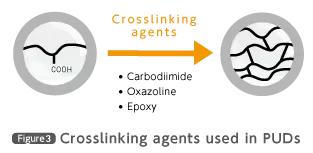
In contrast, the polymer type is a high-molecular-weight urethane resin dispersed in water that can readily form a film simply by drying. A type containing carboxyl groups in the main chain can further increase its molecular weight when combined with a crosslinking agent, thereby enhancing adhesion and chemical resistance (Figure 3).
The Role of PUDs as Primer Layers
The primer layer is mainly required to provide the following two properties:
❶Adhesion
❷Blocking Resistance
Blocking refers to a condition in which films stick to each other after winding.
❶ Adhesion
In inline coating, the primer is applied before thermal stretching and the primer layer is formed during the subsequent thermal stretching process. After film formation, the primer layer is required to adhere sufficiently to the substrate and to provide good adhesion to the functional layer subsequently coated onto it.
❷ Blocking Resistance
Films coated with a primer layer are typically wound into rolls and stored. If blocking occurs during storage, problems such as film tearing may occur when the film is unwound in the next process. Blocking is more likely under high-temperature, high-humidity storage conditions. Anti-blocking agents (fine particles) are commonly used to prevent blocking; however, this alone is not sufficient, and improving the primer’s inherent blocking resistance is also required.
Adhesion to the substrate film and functional layer can be improved by controlling the physical properties and polarity of the PUD primer. The backbone of a PUD consists of soft segments and hard segments. Soft segments mainly correspond to the amorphous portion of the polyol, whereas hard segments are crystalline portions formed by urethane and urea linkages. By combining these segments, physical properties can be controlled from hard to soft.
In addition, highly polar groups such as urethane and urea linkages can be introduced, and a backbone with polarity similar to that of the substrate and functional layer can also be incorporated.
Our thermoreactive PUD primers are based on low- to medium-molecular-weight resins, providing excellent wetting and permeability, which facilitates the development of robust adhesion to the substrate. However, because a thermal curing reaction is required after coating, curing may be insufficient depending on the line speed and drying temperature that the user wishes to run, which can result in poor blocking resistance. In contrast, polymer-type PUD primers, with their higher molecular weight, more readily exhibit blocking resistance, but it is difficult to achieve the high level of adhesion obtained with thermoreactive types.
To combine the advantages of both types, we developed a polymer-type primer that provides adhesion to PET substrates at a level equivalent to our current thermoreactive type.
Development of a Polymer-Type Primer
The newly developed polymer-type primer for PET substrates incorporates a backbone with polarity similar to both PET and the functional layer (our proven UV-curable resin for optical applications). When used in combination with a crosslinking agent, it enhances adhesion to both PET and the UV-curable resin. As a result, no peeling was observed in a cross-cut cellophane tape peel test of the three-layer structure (PET/primer/UV-curable resin), indicating good adhesion. Because it is a polymer type, it also provides good blocking resistance under high-temperature and high-humidity conditions. In addition, it eliminates the need for pH adjustment of the formulation, which was required for our thermoreactive PUD primer, thereby improving handling (Table 1).
Table 1Evaluation of adhesion and blocking resistance for the developed product
|
Developed product |
Current product (thermoreactive type) |
| PET/Primer/UV-curable resin, Initial adhesion |
100 |
100 |
| Blocking resistance |
◎ |
〇 |
- ■Substrate film
- PET (No corona discharge treatment)
- ■Primer coating method
- Primer dry film thickness: 150 nm (Initial adhesion); 1 μm (Blocking resistance), Primer drying conditions: 180°C × 1 min, pH adjustment (thermoreactive type only): Adjust by adding 0.2–0.3 parts by weight of sodium bicarbonate per 100 parts by weight of ELASTRON (as supplied).
- ■UV-curable resin coating method
- UV-curable resin: epoxy acrylate, UV-curable resin film thickness: 10 μm, UV curing conditions: cumulative UV dose of 600 mJ/cm²
- ■Evaluation method
- Initial adhesion: cross-cut cellophane tape peel test (1 mm-square) (Remainder %), Blocking resistance: 20 h at 40°C and 95%RH
◎: no blocking, ○: almost no blocking
Development of a Primer with Adhesion Durability after UV Exposure
In recent years, optical films have become increasingly sophisticated. During the curing process for more complex functional layers, the primer layer may be exposed to UV light before the UV resin is coated. Our current thermoreactive primer has some UV durability; however, repeated UV exposure tends to slightly reduce its adhesion to the UV-curable resin applied afterward. In contrast, the newly developed polymer-type primer maintains adhesion to both the substrate and the UV-curable resin even after UV exposure, confirming further improvement in adhesion durability after UV exposure (Table 2).
Table 2Evaluation of adhesion durability after UV exposure for the developed product
|
Developed product |
Current product (thermoreactive type) |
| PET/Primer/UV-curable resin, Adhesion durability after UV exposure |
100 |
100 |
- ■Substrate film
- PET (No corona discharge treatment)
- ■Primer coating method
- Primer dry film thickness: 150 nm, Primer drying conditions: 180°C × 1 min, pH adjustment (thermoreactive type only): Adjust by adding 0.2–0.3 parts by weight of sodium bicarbonate per 100 parts by weight of ELASTRON (as supplied).
- ■UV-curable resin coating method
- UV-curable resin: epoxy acrylate, UV-curable resin film thickness: 10 μm, UV curing conditions: Prior to coating the UV-curable resin, apply a cumulative UV dose of 600 mJ/cm². After coating the UV-curable resin, cure with a cumulative UV dose of 600 mJ/cm².
- ■Evaluation method
- Cross-cut cellophane tape peel test (1 mm-square) (Remainder %)
Expansion into Non-Optical Applications
Based on its good handling and performance, the developed polymer-type primer is also being extended to non-optical film applications. One example is a primer for inorganic oxides used in gas barrier films. A transparent gas barrier film can be obtained by depositing an inorganic oxide layer on a PET film. Silica or alumina was deposited by sputtering onto PET films coated with the developed product, and the resulting films showed high initial adhesion. In addition, adhesion was maintained even in the wet state immediately after hot-water immersion, indicating that the primer can be used under high-humidity conditions (Table 3).
Table 3 Adhesion evaluation as primers for inorganic oxides
|
Test conditions |
Developed product |
Current product (thermoreactive type) |
| PET/Primer/SiO2 |
Initial adhesion |
100 |
100 |
| Adhesion after hot-water immersion |
〇 |
× |
| PET/Primer/Al2O3 |
Initial adhesion |
100 |
95 |
| Adhesion after hot-water immersion |
〇 |
× |
- ■Substrate film
- PET (No corona discharge treatment)
- ■Primer coating method
- Primer dry film thickness: 1 μm, Primer drying conditions: 120°C × 1 min, pH adjustment (thermoreactive type only): Adjust by adding 0.2–0.3 parts by weight of sodium bicarbonate per 100 parts by weight of ELASTRON (as supplied).
- ■Inorganic oxide deposition method
- Deposition method: sputtering, Inorganic layer thickness: 30–50 nm
- ■Evaluation method
- Initial adhesion: Cross-cut cellophane tape peel test (1 mm-square) (Remainder %), Adhesion after hot-water immersion: Evaluate the surface by rubbing while wet with a finger immediately after immersion. ○: no peeling, ☓: peeling observed
Conclusion
As display visibility improves and displays become thinner, optical films are required to deliver even higher performance. Accordingly, primers are being asked to provide higher levels of adhesion durability after UV exposure and to achieve strong adhesion even with thinner primer coatings. In addition, UV-curable coatings used to impart functionality are becoming increasingly diverse, and primers are required to adhere to a wide range of functional layers.
Building on our long-established PUD primer technology, we will further develop this technology to address these challenges and enhance our competitive advantage in the market.

Fumiya Kaneko
Device Materials Research Group,
Electronics & IT R&D Department,
Electronics & IT Business Division,
Business Headquarters
References
- 1) Fuji Chimera Research Institute, Inc., “2025: Current Status and Future Outlook for Display-Related Markets” (Display devices; shipment area; CAGR (2030/2024)).
- 2) DKS Co. Ltd., ELASTRON Technical Data.